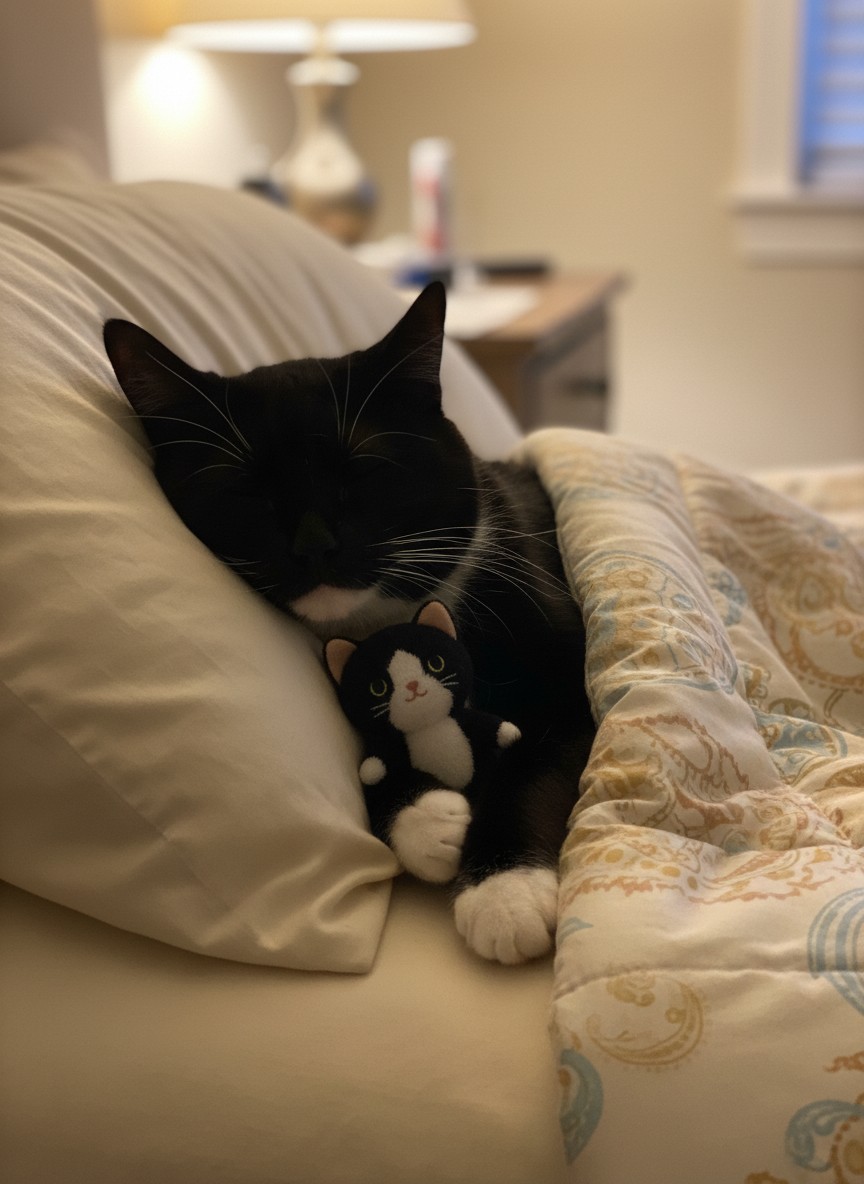
I ran across this story online recently, and while I haven’t been able to independently verify its legitimacy, something about it stayed with me. The details, the emotion, and the quiet humanity woven through it felt worth sharing. Whether fully true, embellished, or a dramatization inspired by real events, the heart of the story carries a kind of tenderness that’s rare to stumble upon. What follows is the version I encountered—moving, uncertain, and full of the kind of small, ordinary miracles that make us stop and reconsider the world around us.
━⋅•⋅⊰∙∘☽༓☾∘∙⊱⋅•⋅━
You don’t expect a moment of small kindness to rearrange your entire life. You don’t expect it to echo beyond a waiting room or become the thread connecting two families who never knew the other existed. But sometimes the smallest gesture — a child handing over a stuffed rabbit — is the thing that opens every door that was meant to be opened.
It began the day Mabel gave away Mr. Bunny.
She was seven. They were at the hospital for a routine checkup. And by the time the nurse called her name, Mr. Bunny — her constant companion since toddlerhood — was tucked firmly into the arms of another little girl sitting across the waiting room. A quiet girl with pale skin and dark circles under her eyes. A girl who looked like she had forgotten how to hold anything soft.
That girl was Nikki.
Mabel’s mom didn’t know her story then. She didn’t know her father. She didn’t know anything except the look on her own daughter’s face as she walked out of that waiting room empty‑armed and steady‑hearted.
“She needed him more, Mama,” she whispered on the ride home.
Her voice was so calm, so sure, that it stopped me. Inside her daughter was something I didn’t recognize yet but would come to rely on: a grace that arrived before understanding.
She didn’t know yet that something much larger had begun to move toward their door.
The Knock
Two days later, Mabel’s mom was folding laundry when the world outside went still. A long black limousine eased to a stop in front of their building — gleaming, impossible, out of place against the cracked sidewalk.
There are moments when your instincts outrun your thoughts. She went to the door before anyone could knock, but the man in the black suit knocked anyway. Three firm raps.
His eyes were tired, glistening. “Ma’am, I need to see your daughter. It’s urgent.”
She stepped into the hallway, pulling the door almost shut behind me. “Do you understand how that sounds to a single mother?”
He nodded, swallowing. “My name is Roger. My daughter is Nikki.”
The girl with the rabbit.
She did not invite him in. He gave her his license, his card, and a phone number for Dr. Patel — pediatric oncology. “Call her,” he said. “Not from out here. From inside your home, with the door locked. I’ll wait.”
Part of her refused to accept any of this as real. But something trembling beneath his formality — a man stretched past exhaustion — made her pause.
She called the hospital’s main line instead of the number he gave. When Dr. Patel picked up, her voice was clipped but warm.
“That’s Roger,” she said. “He’s been here every day for eight months. He hasn’t slept since Christmas. Whatever he’s asking you for… he’s her father. And he’s desperate. The rest is your call.”
Suddenly the limo made sense.
Desperation comes dressed in whatever someone can reach. A suit. A business card. A terrible idea. A father who has run out of ways to save his child.
She turned the deadbolt and told Mabel to get her coat.
The Visit
The limo felt less like a vehicle and more like a confessional. Roger sat across from us, fingers interlocked so tightly they looked like they might break.
He told us everything — or, as he said, “the beginning.”
Nikki had been sick for over a year. Her mother had died of the same illness. Nikki had stopped talking. Stopped eating. Stopped letting the nurses help her. Until Mabel handed her Mr. Bunny.
“She held it all night,” Roger whispered. “She said she wanted to be brave. Like the little girl with the kind eyes.”
They arrived at a private wing of the hospital, floors gleaming like glass. A nurse was already waiting. Inside, Nikki lay against white pillows, small and fragile, Mr. Bunny tucked beneath her arm.
When she saw Mabel, something lit up inside her — something you don’t see often on a pediatric oncology floor.
“You came,” Nikki whispered.
Mabel moved toward her as though pulled by gravity.
Their voices lowered into whispers I couldn’t hear. Their foreheads nearly touched. It was as though they had always known each other, and were simply resuming a conversation they started long before.
The Truth
In the hallway, Roger told Mabel’s mom the rest.
His wife had been a bone marrow donor.
After she died, the hospital notified him that her donation had saved the life of a child treated there years earlier.
He didn’t know who.
Until he saw Mabel give Nikki that rabbit, and Nikki smiled — truly smiled — for the first time in weeks.
“That’s when I wondered,” he said, his voice fraying. “When she walked up to Nikki so gently… I thought, what if the child my wife saved was already standing in front of us?”
Her knees went weak.
“Mabel was treated at this hospital when she was four,” he said. “Wasn’t she?”
She was.
And for the first time, she understood why the world had shifted around us so strangely.
Roger looked toward the room where their daughters were laughing. “My wife was Mabel’s donor.”
The woman who saved her daughter’s life had left behind a daughter of her own — and that daughter was now fighting for hers.
Aftermath
Days later, the tests came back.
Mabel was not a match.
The news broke something inside her she hadn’t realized she had been holding in place. She cried in the parking lot, gripping the steering wheel until her palms ached.
But Roger did not quit.
He launched a donor drive in his wife’s name. Mabel’s mom stood beside him at every event, Mabel at her side holding a sign she decorated herself in marker and glitter. Weeks later, a stranger across the country matched Nikki.
And Nikki got better.
She came home.
The two girls became inseparable — trading Mr. Bunny between sleepovers like a tiny, worn crown. They grew into a kind of friendship that didn’t require understanding the past, only living into the future.
One night she watched them on the rug, laughing over something only children understand, the rabbit propped between them like a witness.
And she realized something she had carried alone:
Kindness had been moving quietly between their families long before any of them knew the others existed.
A donation.
A recovery.
A rabbit.
A smile.
A knock on the door.
Two little girls becoming who they were meant to be.
Sometimes the smallest act holds open a door that was supposed to open.
Sometimes the smallest child becomes the one who leads you through it.