One thing I have mentioned before about being at my mother’s house is that she has cable TV. Hundreds of channels and still rarely anything I actually want to watch. However, there have been a few things of interest on the Smithsonian Channel. For example, last night they ran a show called King Tut’s Final Mystery.
Ever since Howard Carter and his team discovered – and let’s call a spade a spade, pillaged – King Tut’s tomb in 1922, the boy king has captivated the world. So how did the most iconic Egyptian king ever, actually die? And why so young? That is what the scientists featured in this show were out to discover.
We know that the 19-year-old king’s death was sudden and a surprise. How do we know this? Several things: first, his burial chamber was small, cramped, and hardly decorated. Secondly, there was something present in Tut’s tomb that has never been present in any other tomb: mold. The 3,000-year-old mold is indicative of the walls being hurriedly painted on wet plaster and then the chamber sealed. So whatever killed the pharaoh was not something anyone could have foreseen.

click to enlarge
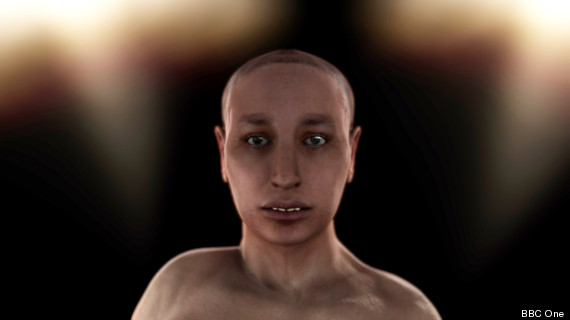
Check out the reconstruction of Tutankhamun. I find it interesting the dramatic contract between this image and the beautiful youth of his death mask. Notice the pronounced overbite and it is also believed that he had a cleft palate.
click to enlarge
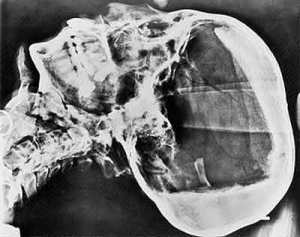
King Tut’s mummy was first x-rayed in 1968, causing speculation that the boy king had been murdered by a blow to the back of the head. If you look at the x-ray, there are some bone fragments inside the cranial cavity. People believed, and rightly so, that a killing blow to the back of the head would propel bone fragments inward. The problem with this is that the mummification process would have blown them back out again. So the fragments were somehow created post-mummification. The site Two Views mentions that some scientists believe that the bone fragments are not even from the skull, but are actually part of the first vertebra that were broken off during mummification. (I’m not sure if I entirely concur with this – more on this later). Either way, Myth #1 debunked.
Another thing the x-rays revealed is a broken femur. This is not an easy task. The femur is the largest bone in the body and it takes a tremendous amount of force to fracture it. This injury to Tut was pre- or peri-mortem (before or around the time of death). Personally, I believe (based on information that I have) that this injury happened close to the time of death. For one thing, the x-ray shows a very clear break. For another, none of the scientists mentioned the presence of ossification (bone formation) that would have indicated any type of healing process. Primary callus begins to form within two weeks, so it is my educated guess that death ensured within two weeks of this injury.
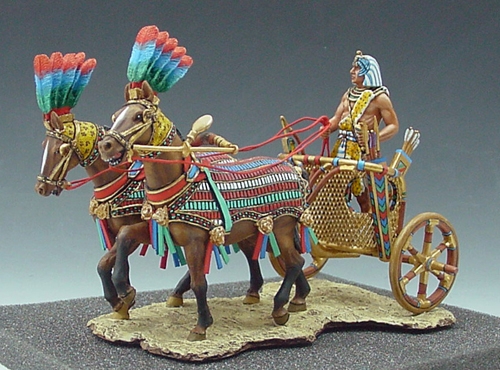
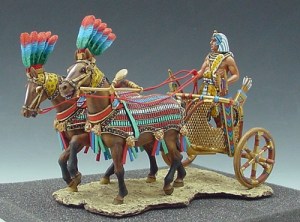 But how he broke his leg led to another theory about his death. Perhaps he died in a chariot accident? The scientists decided to test it. How fast can a chariot even go? And would it be fast enough to cause a fracture? After several passes urging the horses on, the top speed reached was 21 miles per hour. Enough to assure that any bone fracture would be possible – even the femur. It seems likely that accidents with these “sports cars of their day” would not have been few and far between, so it seems we might be on to a valid hypothesis here.
Further examination in the “virtual autopsy”, which included more than 2,000 CT scans, showed that Tutankhamun was actually born with a club foot. This deformity would have caused the young king to walk with a limp and more than likely use a walking stick. This affliction would make it unlikely that he would be able to use a chariot. But this revelation made understanding some of the artifacts in his tomb a bit easier: it contained 139 ebony, ivory, silver and gold walking sticks. Myth #2 debunked.
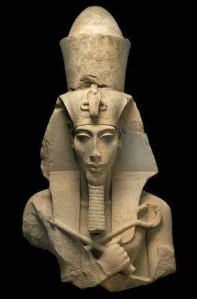
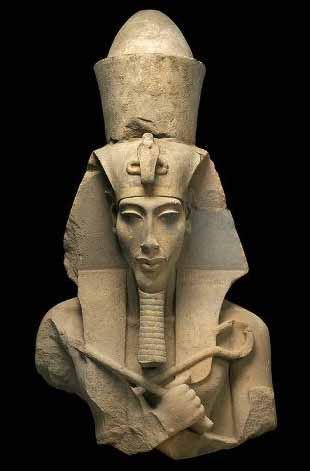
Akhenaten
Okay, so we have debunked the two major theories of how Tut died. So what did kill the 19-year-old king? Maybe we should step back and take a look at the larger picture. In order to do that, we need to know, for certain, who Tut’s parents were. It was generally believed that Akhenaten was Tut’s father because it was generally the way it was for a son to take the father’s place on the throne. However, this was not always the case. So a DNA profile was taken and compared to the one taken from Akhenaten, known as KV55. It was a match. And it was a “probability of better than 99.99 percent” certainty that Amenhotep III is Akhenaten. So we have a good paternal lineage for Tut now.
But what about Tut’s mother? After comparing Tut’s DNA sample to that of Queen Tiye, the wife of Akhenaten, there was no match. And there was not a match to any of Akhenaten’s known wives. Okay, our hands are not tied quite yet and we are finally able to find a maternal match with sample KV35YL, the DNA sample taken from a mummy designated “The Younger Lady”, found lying beside Queen Tiye. Here is where the water gets a bit murky. The Younger Lady was the sister of Akhenaten, making Tut the product of incest.
So the information of the incest and the club foot led to a question of: are there any other hereditary problems that could have led to Tut’s early death? If you go back to Tut’s great grandfather, Thutmose IV, all the men have wide hips and accentuated female characteristics. This is due to a condition known as gynecomastia. Also, they died early. It is estimated that Thutmose IV died at an age between 25 and 33 years old; Amenhotep III died at the age of 38 or 39 and Akhenaten died when he was between 28 and 45, although it is commonly believed to be on the younger ends of the scale.
Now let’s take into account the religious visions of Tut’s father and great grandfather. Thutmose IV while taking a rest after hunting had a vision of the Sphinx. It told Thutmose that if he uncovered all the sand that engulfed the feet of the Sphinx, it would make sure he ascended the throne. This vision is chronicled in the Sphinx Stele. Akhenaten had a religious vision that caused him to turn against the polytheistic pantheon, build the city of Amarna to honor the one God, Aten.
What can cause all of this: young death, religious visions and a hereditary problem compounded by a small gene pool? The only really good fit is familial temporal epilepsy. And when you look at all the information and that fact that the epilepsy would not have been treated in King Tut, it seems likely that he had a grand mal seizure, fell (causing the broken femur) and passed away either due to the fall or through sepsis (infection) caused by the damage of the fracture.
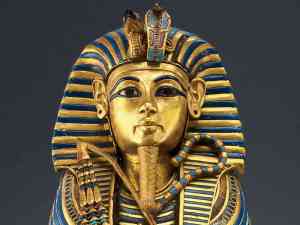 There is more damage to the body that just what I have covered. However, I did not go over it because it was done post-mummification. In fact, it was done by Carter and his crew when they removed the death mask from the mummy, as it was essentially glued to the body. That is why I said earlier that I did not concur with the bone fractures done during mummification. I find it far more likely that it was just more damage done by Carter.
I would like to conclude by saying that this was a fascinating documentary and if you get the chance to see it, do. I think you will find it very informative.





 Thomas Cole, View from Mount Holyoke, Northampton, Massachusetts, after a Thunderstorm or The Oxbow, 1836, The Metropolitan Museum of Art



 cyrakitty